The Best Cat Beds for Anxious Cats (That They'll Actually Use)
If you have an anxious cat, you've probably already tried the obvious things — a calming collar, a pheromone diffuser, maybe a bed from a roundup article that your cat sniffed once and never touched again. The problem usually isn't the product. It's the shape. The best cat bed for anxious cats looks very different from the open, cushioned beds that dominate most pet store shelves — and once you understand why, the answer becomes obvious.
Cats are simultaneously predator and prey. That dual nature never went away, no matter how comfortable your living room is. When an anxious cat rests, their nervous system stays partially alert — scanning for threats, monitoring exits, keeping track of what's moving around them. An open bed asks them to lie fully exposed with no cover overhead and visibility on all sides. For a calm, confident cat, that might be fine. For an anxious cat, it's the opposite of restful.
This is why anxious cats do what they do: they disappear under beds, wedge into closets, tuck behind the dryer. They're not being difficult. They're finding the enclosed spaces their instincts tell them are safe. As we covered in our post on why cats sleep in enclosed spaces, this behavior is rooted in thousands of years of survival instinct. The cat who slept in an open field didn't last. The cat who slept in a covered den did.
A flat or open bed will never replicate that feeling — no matter the price, no matter the material.
The non-negotiable is enclosure. A bed that works for an anxious cat has walls and a covered top. Everything else — fabric, fill, color — is secondary to that single design requirement.
A covered bed does two things an open bed can't. First, it removes the visual exposure that keeps an anxious cat on edge. When your cat can't be seen from above, their nervous system gets to stand down. Second, it traps body heat, creating the warm, enclosed environment that genuinely mimics a den. This isn't just comfort — it's a physiological signal that the space is safe.
Here's how the main bed types compare for an anxious cat:
| Bed Type | Good for Anxious Cats? | Why |
|---|---|---|
| Flat cushion / open bed | No | Fully exposed on all sides. Keeps anxious cats alert instead of resting. |
| Donut / bolster bed | Partially | Raised edges help with the sides, but the open top leaves cats exposed overhead. |
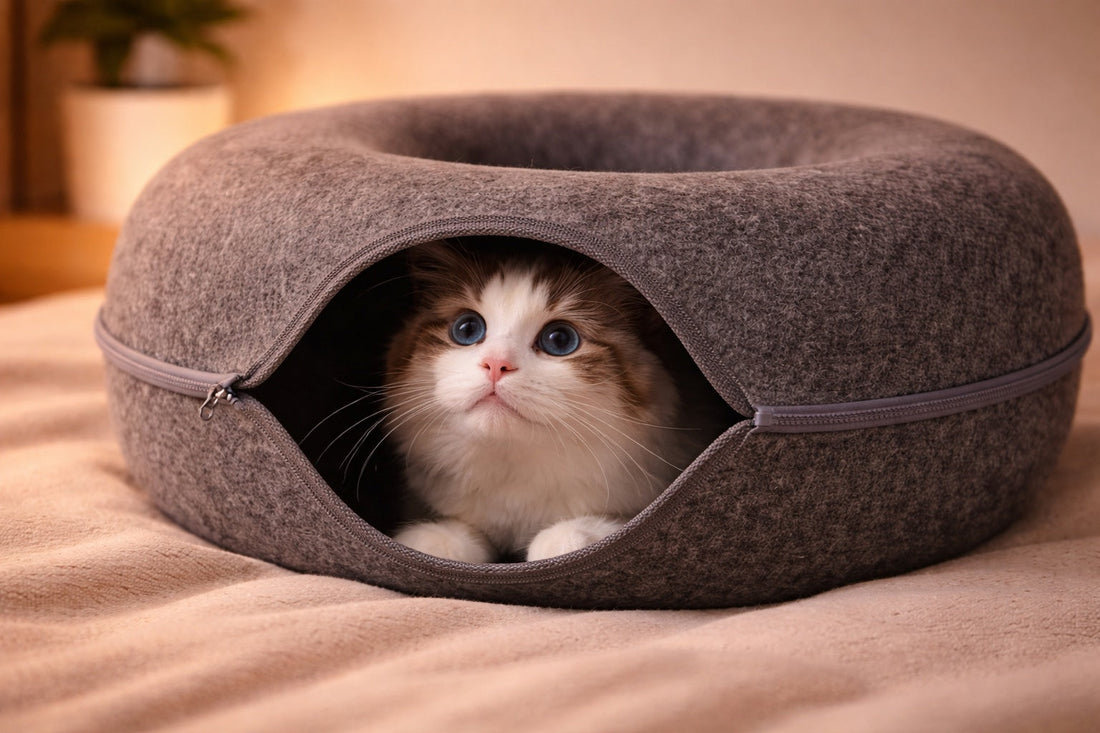
| Cat cave bed | Yes | Enclosed on all sides with a covered top. Mimics a den. Meaningful reduction in stress. |
| Cat tunnel bed | Best option | Full enclosure plus a tunnel entrance that activates hunting instincts — calms anxious cats on two levels at once. |
A cat cave bed is genuinely good for anxious cats — the enclosure alone makes a real difference. But a cat tunnel bed solves something a cave doesn't: boredom anxiety.
Some cats aren't just anxious because they feel exposed. They're anxious because they're understimulated. They need to stalk, explore, and hunt. A standard cave is passive — it offers safety, but nothing to do. A tunnel bed is active. The tunnel entrance triggers your cat's prey drive. They dart in, turn around, peek out, dart in again. The physical engagement burns nervous energy. The enclosed space provides calm after the fact. It's the difference between a quiet room and a quiet room with something to engage with.
This is the same principle we explored in our post on cat cave beds versus regular cat beds — the shape of a bed determines whether a cat uses it, and for anxious cats, that principle matters even more than it does for the average cat.
Even the right bed takes time. Anxious cats don't explore new things on command. A few things that speed up the process:
Place it where they already hide. If your cat disappears under the desk or behind the couch, that's where the bed goes — not in the center of the room where it looks nice, but in the spot they already choose when they feel unsafe.
Add your scent. A worn t-shirt or a familiar blanket placed inside the bed makes it smell like safety before your cat ever sets foot in it. Avoid catnip — it can overstimulate anxious cats rather than calm them.
Leave it alone. Don't hover, don't demonstrate, don't place your cat inside it. Set it down and ignore it for a few days. The less pressure around the bed, the faster an anxious cat decides it belongs to them.
Give your cat a bed that feels safe enough to use.
The Cozy Cat Tunnel Bed is built for exactly this. The fully enclosed interior and tunnel entrance make it one of the most effective options for anxious cats — and the soft, washable felt construction means it holds up to daily use without losing its shape. If you've cycled through beds your cat refuses to touch, this is the one worth trying.
Shop the Cozy Cat Tunnel BedThe best cat bed for an anxious cat isn't the softest one or the most expensive one — it's the one that makes them feel hidden. Open beds ask cats to sleep exposed. Enclosed beds let them sleep safe. If your cat consistently hides rather than resting in their bed, that behavior is telling you exactly what they need: a bed that works the way a den does, not the way a cushion does.